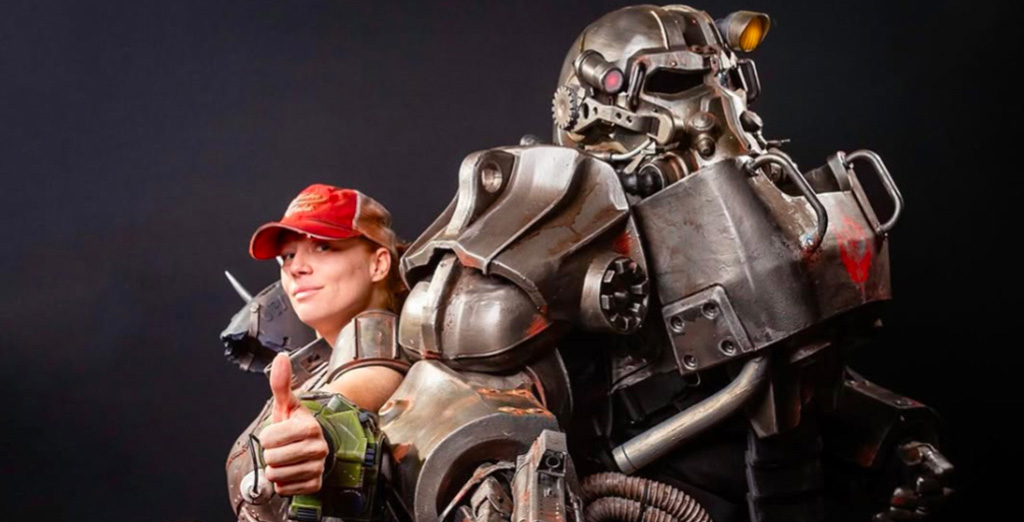
Only imagine witnessing the world you have seen on the screen while playing your favorite video games or watching TV series at a cosplay or convention event! Thanks to 3D printing and talented enthusiasts, making post-apocalyptic environments is more real than ever. Recreating life-size Fallout props and building incredible video game 3D models has become a hobby for Tyler, who has partnered with his best friend Autumn and now lets other fans see (and touch) the fantastic pieces displayed at popular events across the US.
The hobbyist behind the Fallout Xperience, a post-apocalyptic display that travels to various conventions, shares his story and tips for creating amazing Fallout props using affordable desktop 3D printers and premium STL files of 3D game models from Gambody.
Fallout Props
Before discovering the incredible adventures and 3D printing experience by Tyler, explore the fantastic Fallout 3D prints you can make using your printer and highly detailed STL files of models and figures from this universe.
Read also: Your Best 3D Printer for Cosplay (Create Impressive Armor, Helmets, and Costumes Like a Pro).
1. Hello Tyler, could you please introduce yourself and your project to Gambody community?
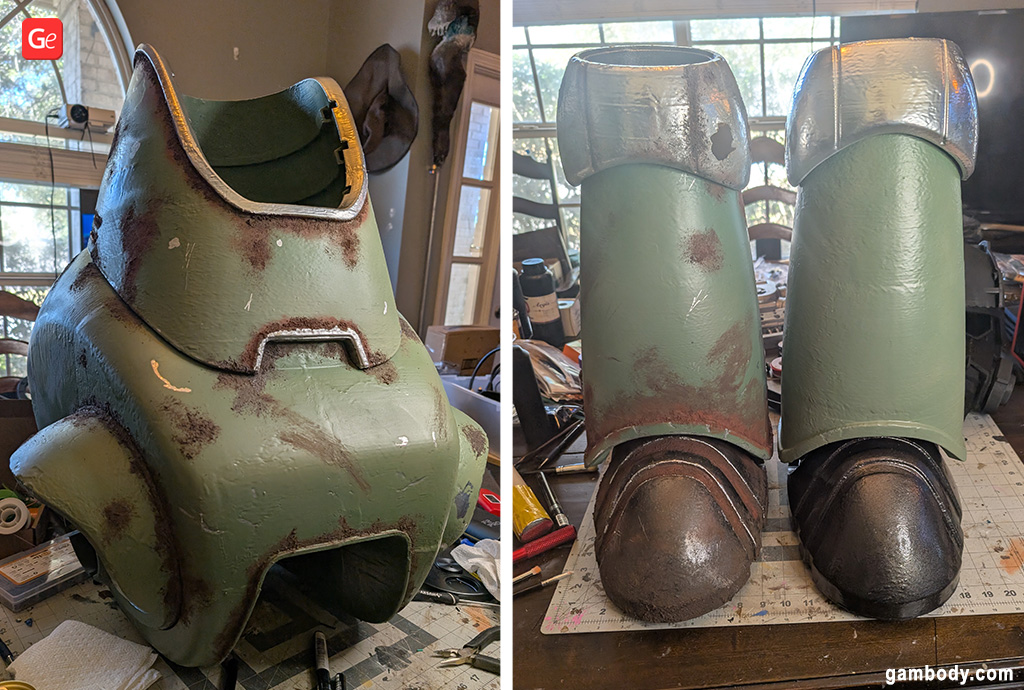
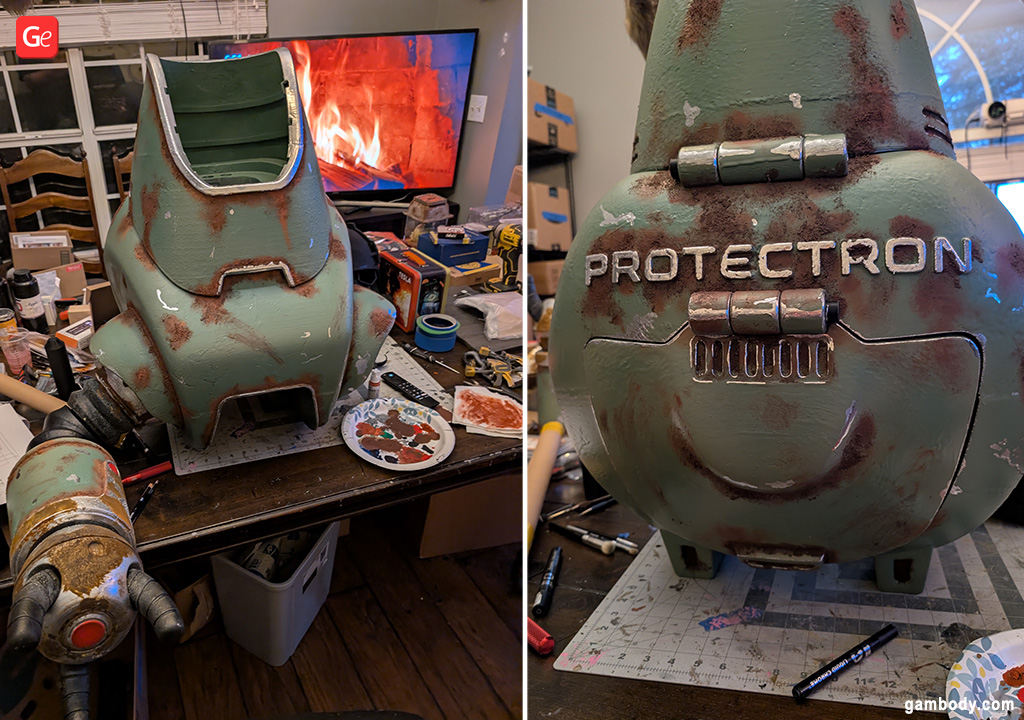
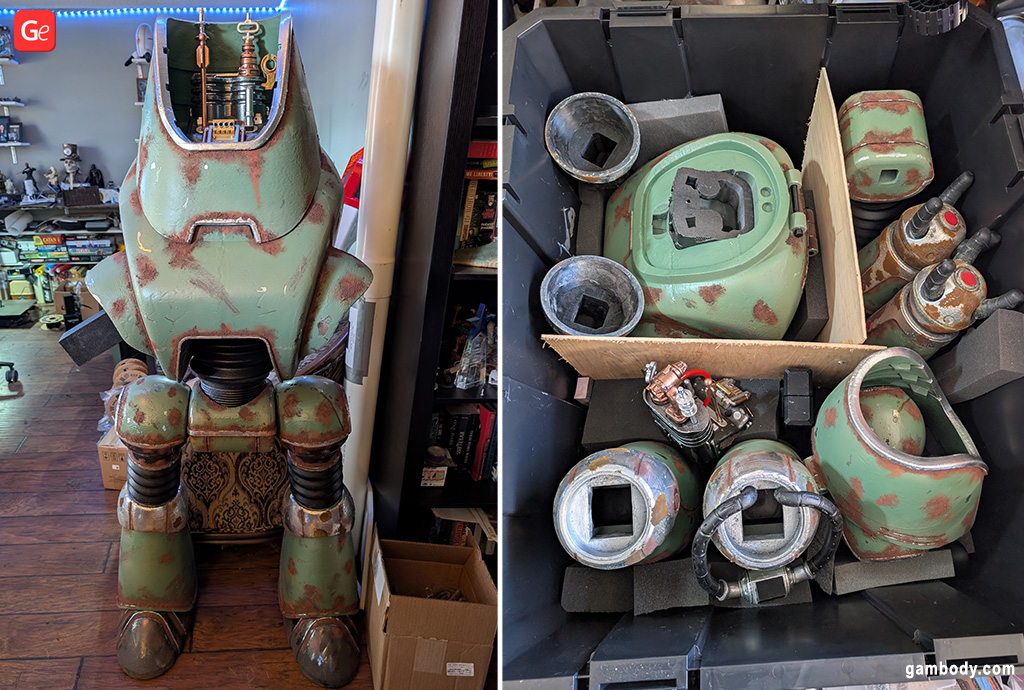
Hello all! I am Tyler. I’m 37. I work professionally on flight simulators, alongside my business partner and best friend, Autumn, who partners with charity organizations to raise money. I create ridiculous life size 3D print projects and impressive Fallout props! Over the past 6 months, I have been busy building a life-size Protectron based on Gambody models, which are awesome for full-scale 3D printing thanks to their incredible detail and resolution. This was a fun build and an awesome challenge for me to complete.
2. When did you first learn about 3D printing? Do you remember your very first 3D printed project? What was it, and what did you learn from it?
I first learned about 3D printing a long time ago, when it was still in the conceptualization phase and not really scaled or priced for the civilian market. In 2020, my wife got me an XYZprinting da Vinci Pro with a fully enclosed 7-inch print bed. It was not ideal for learning how to 3D print. It was very complicated and crazy hard to use properly. As far as first prints, I think I was making silly, small items like the rockachu and rockevee to hide around my friends’ houses as a joke.
3. At what point did you realize 3D printing could become a serious tool for large-scale cosplay builds?
In 2021ish, I decided I wanted to make a subject delta/big daddy from BioShock (a first-person shooter video game) and found some awesome 3D printing files for the diving bell helmet. I had 2 first- or second-generation Ender-3 printer with no auto-leveling and no other bells and whistles. I created this massive underwater dive helmet by cutting the model into hundreds of pieces and painstakingly assembling them.
I have won tons of awards with that costume and was featured by 2K Games on a few different occasions for that build. That’s when I realized that even with the small form printers, I could make awesome massive lifelike 3D printed projects.
4. What keeps you motivated to take on such ambitious, time-consuming 3D printing projects?
To be honest, this all started as a hobby, morphed into costuming, and just kept going into massive-scale builds. It is as much to keep busy and keep my mind active as it is anything else. Being able to make the things that, as a kid or teenager, I would have lost my mind over is amazing to me. To be able to bring everything from my childhood to life with my own hands motivates me, but really, bringing those items and creatures to life and letting other people experience that magic and joy is the primary motivator.
5. How did the idea for The Fallout Xperience come to life? Why did you choose the Fallout props as the foundation of your project?
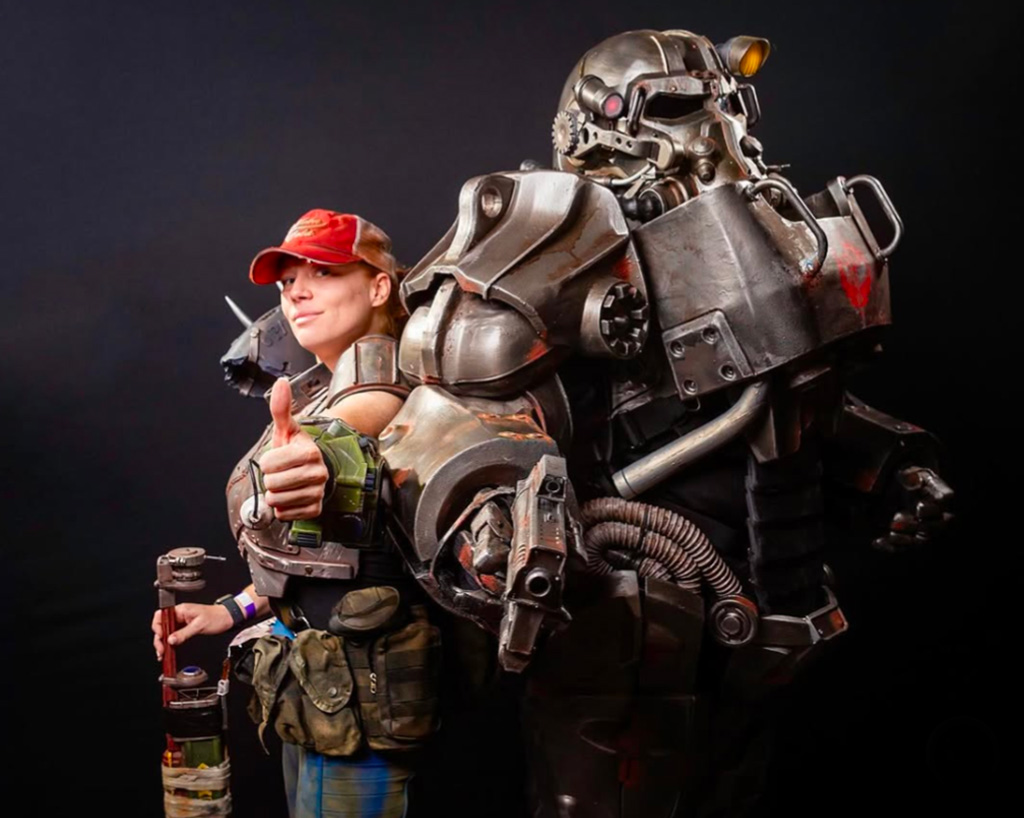
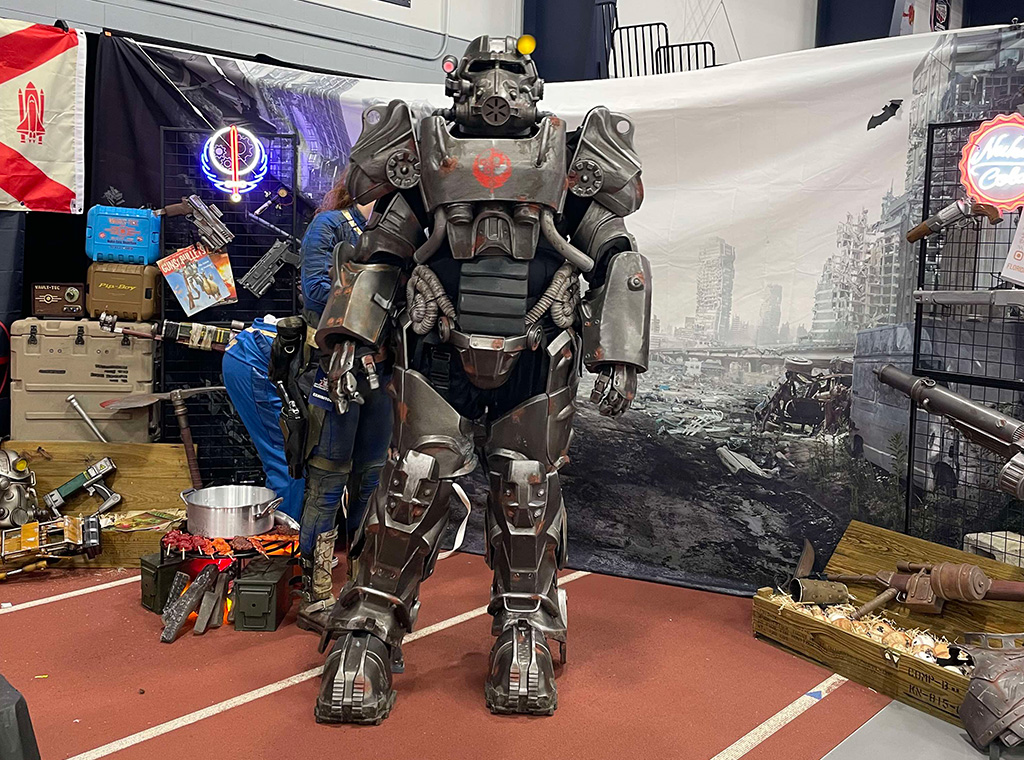
I created this awesome set of T-60 Fallout Power Armor 3D print projects based on models from lilykill. I used it for my personal cosplay brand, ConCrawlerCosplay, as a guest at conventions. Pretty early on, my best friend Autumn from AutumnDoesCosplay and I kind of just decided it would be cool to stomp around in power armor, so we created what was then the “Florida Brotherhood of Steel”. I had really good relations with the show runner of InfinityCon here in northern Florida, and one year, I think in 2022 or 2023, he had me as the primary cosplay guest and gave me a huge space to showcase my enormous builds (I had done the previously mentioned BioShock build and a life-size Lord Ainz from Overlord). We used it as a test bed to see if the concept really had any traction in the convention circuit. I think it was like me in power armor, her in a killer wasteland vault/raider costume, and like a crate of baseball grenades I had made from old baseballs and a wasteland backdrop. Very not professional or well put together. Turns out, people absolutely lost their minds over it.
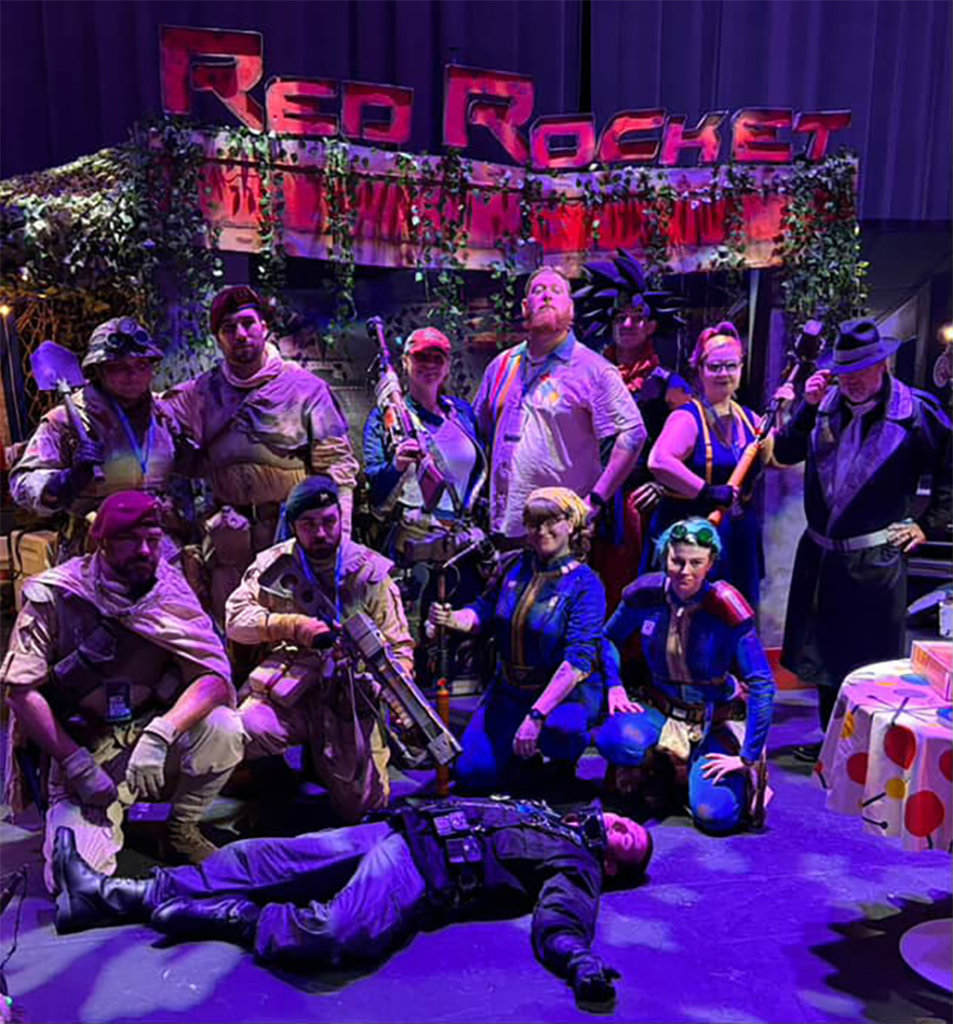
As it evolved, we realized we wanted to encompass more than just the Fallout Power Armor 3D print aspect and really create something akin to it, putting people into the game. We took inspiration from the 501st Star Wars group in the way that they bring these massive sets to conventions and set them up for fans to walk through.
The Fallout universe in itself presents so much in the way of content that it’s virtually endless in scope. It has so many different levels of lore, environments, and creatures that you get to explore and draw inspiration from, making it something for everyone. I had already done large 3D printed costumes, so large set items seemed like a natural next step.
6. You operate as a self-funded charity initiative — what causes do you support, and what is the core mission behind your work?
Last year, we supported St. Jude Children’s Research Hospital. We were lucky enough to get connected with them at GCX Orlando last year and represent them through our fundraising. I think we did about $3,500 that first weekend with them, and realized we could do a lot of good just from doing something we loved anyway. After that event, we went on to raise an additional $15,000 over the course of the summer and fall. About 6 months in total, encompassing 3 or 4 conventions.
This year, we are working with the incredible folks over at The Trevor Project in support of their work with the LGBTQ+ and trans youth community. They run a 24-hour, 7-day-a-week suicide and crisis intervention hotline. Support for this community is critical to us as an organization. Autumn and I both feel that this is something very near and dear to us, as our friends, family, and local community fall very much into that category. Being able to effect real change in the community in which we are is extremely important and rewarding to us. We not only get to raise charity money but have also been able to educate people about the work this amazing charity does.
As far as the core mission, we like to keep it simple and not convoluted. We don’t have some grandiose view or mission to change the world. Autumn and I want to make cool things for everyone to come and experience, and we want to be able to give back to causes and communities we feel strongly about. Ultimately, our message is simple. Be kind, support one another, and try to leave every place a bit better than it was when we got there. Every interaction is a way for us to spread that kindness and joy. Today’s world is tough, overwhelming, and lacking a lot of kindness. Our whole team of volunteers and collaborators is dedicated to this fairly simple message, and the community we are building is based around inclusiveness, compassion, and doing a bit of good.
When people come to see us, it’s not only for the displays and cool Fallout props. It’s for the interactions and the energy we bring. We always have people who come to cons exclusively for us and have repeat attendees who come specifically for the interactions we bring. Sometimes again and again over the course of a weekend.
7. What materials do you most frequently use for your large builds based on video game 3D models ? What type of 3D printers do you primarily use for life size 3D print projects, and why did you choose them?
I currently employ a line of three AnyCubic Kobra Max 3D printers: 2 Kobra 2 Max and 1 Kobra 3 Max. I know a lot of people go for the Bambu Labs 3D printers due to ease of use and how awesome the features are and how clean the prints are, but I always felt that for me, the cost outweighed the features.
Read also: Fast Anycubic Kobra 2 3D Printer Unboxing and Review.
For the cost of the new Bambu Lab large-bed 3D printer, I could buy 2 Kobra 3 Max machines. The Kobra series really has everything I need, and they work amazingly with life size 3D print files. Fast, accurate, and with all the ease-of-use features to make printing easy.
With Anycubic’s update to their slicing program that enables expanded part cutting with the ability to add connectors or pins, and those sorts of things, it brings it into the current phase of printing technology. They also have awesome customer service and go above and beyond to try and help when you have an issue or a random part that breaks that you can’t find anywhere.
For filament, I exclusively use Overture PLA. I know ABS would be better for larger and heavier builds where weight becomes an issue, but the ABS chemical emissions during prints and the enclosed requirements for temps lead me to gravitate to PLA as an easier method. I just use a few extra walls, and this supports all the weight I need.
Other than that, I use Gloop! Brand glue, specifically their PLAGloop! It is amazing and is the best thing I have come across so far. I also use metal heat staples and sometimes carbon fiber for extra strength on my seams. I also have a 3D pen to stuff into gaps and use a woodburner to smooth out all the seams.
8. What are the biggest challenges when printing and assembling massive characters? How do you overcome them?
A lot of the main challenges all stem from weight and weight distribution. Making sure I have all the strength I need to support a life size 3D print isn’t too tough of an engineering feat. The tough part is keeping the model light enough overall to be transportable while maintaining structural integrity and a low center of gravity so it doesn’t fall over on itself.
To overcome this, I usually hollow video game 3D models, leaving a thicker outer shell on the pieces at the bottom and slowly shrinking that towards the top. Then I add more walls at the bottom and taper them as I go higher as well.
Read also: How to Split a Model in Half (Secrets of Large-Scale 3D Printing).
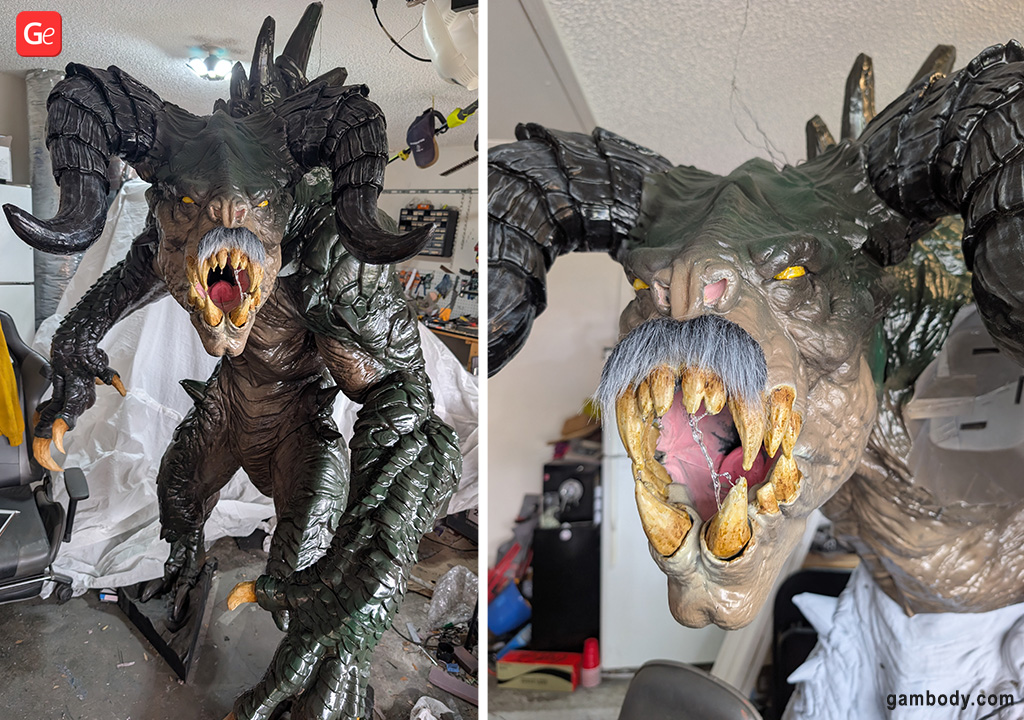
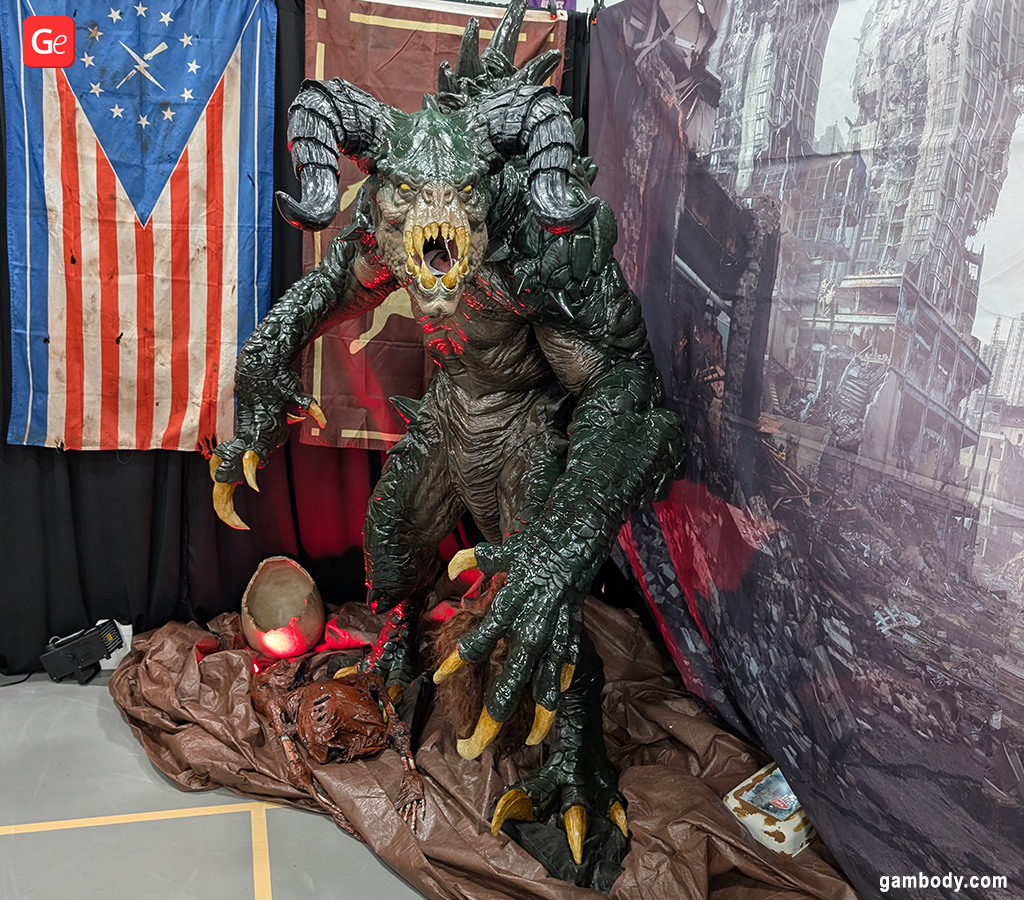
9. Why did Deathclaw become one of your first major video game 3D prints?
I had been wanting for a while to include more creatures in the Fallout Xperience exhibit, and I was originally obsessed with making a mirelurk. Unfortunately, after searching for a while, I couldn’t find one with high enough fidelity to scale to size.
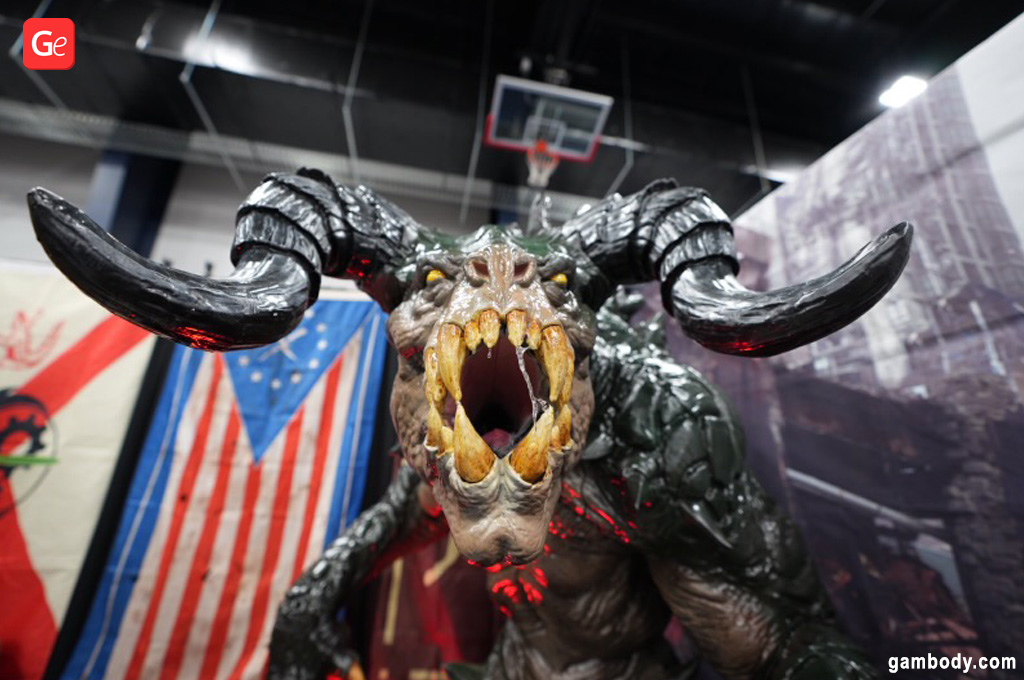
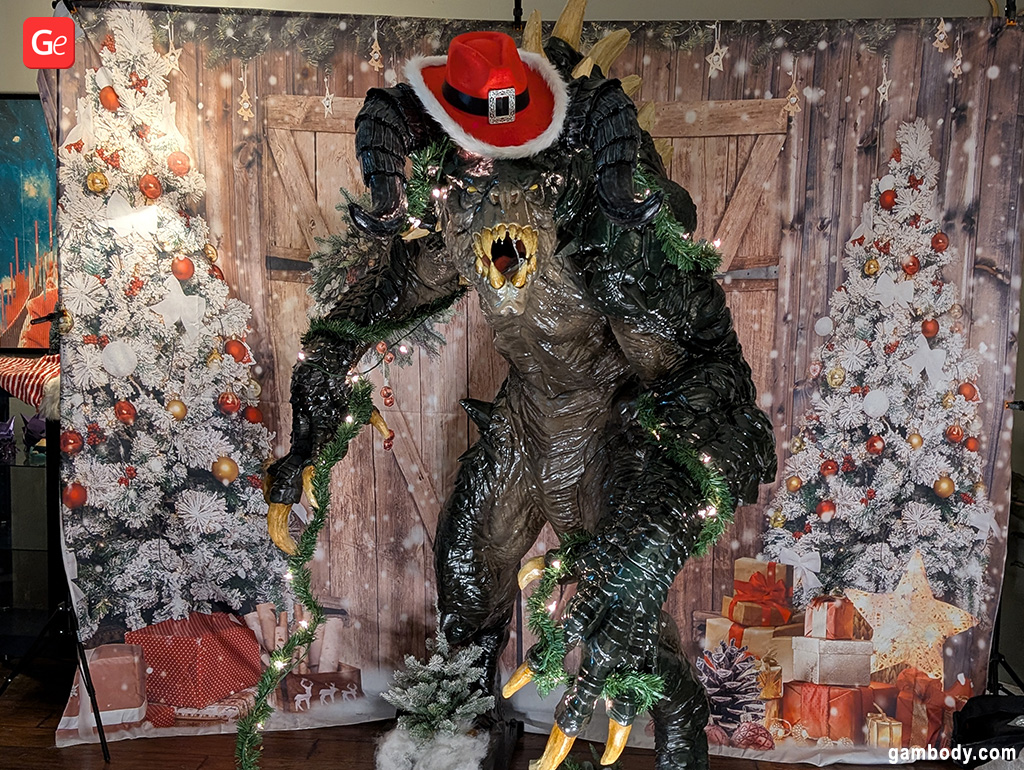
One day, Autumn sent me a link to the Gambody Deathclaw 3D printing files, and I immediately knew that it was going to be the next build. I think the only life size Deathclaw displays in the world other than Dicky, our Deathclaw, are owned by Bethesda studios and displayed in their buildings. That alone made it top of the list to make.
10. Could you share the total print hours required for the Deathclaw Fallout 3D print and how long the printing, post-processing, and painting took you?
I don’t have any hard numbers, but I can do estimates for sure. We started in July of last year and had him finished and debuted in mid-November, so it was only a 4ish month build. With my 3D printers going full tilt all day and night for about a month, I was able to get the printing phase knocked out. 18 hours a day X 30ish days is 540 X 3 printers is 1620 hours. That was probably closer to 1400 or 1500 hours to be fair.
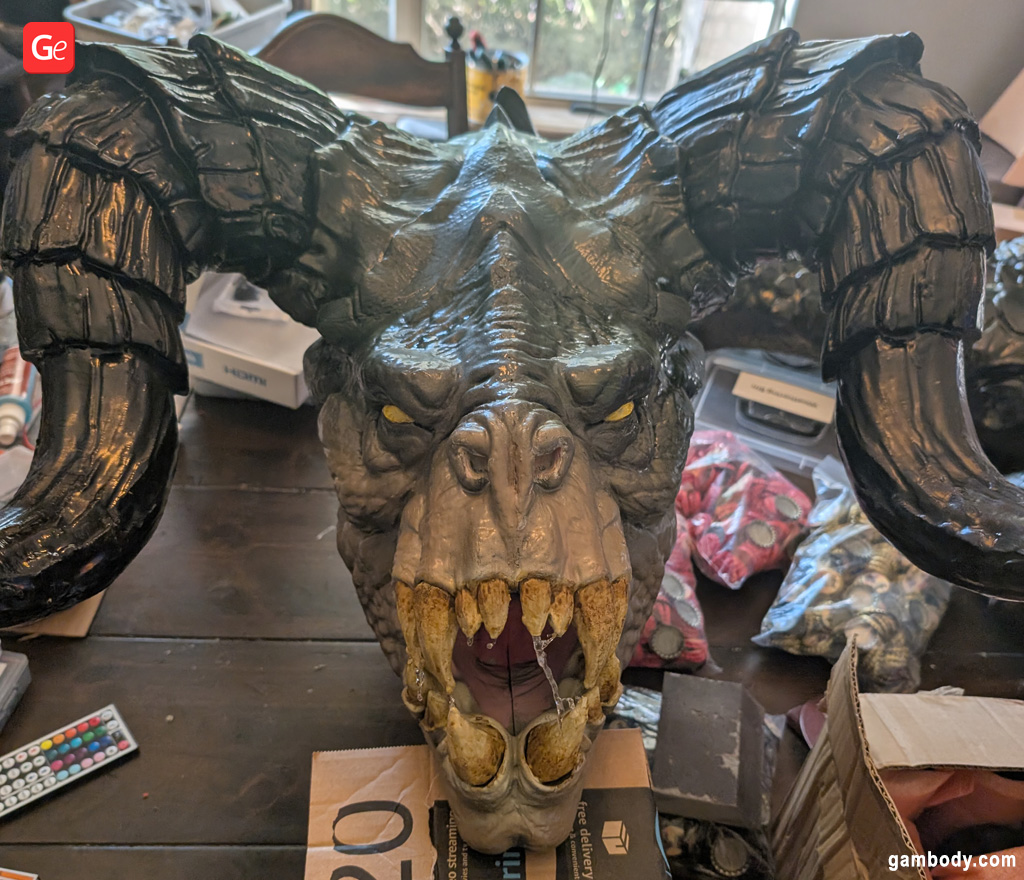
I ran through 2 print heads, some hot ends, nozzles, and a whole mainboard for one of my Kobra 2 Max’s during that time, so there was some time loss. The nice thing about the Kobra 2 Max is that they sell the print head assembly for like 40 bucks, and it takes 5 minutes to change, so when you have an issue, you can swap print heads fast and then troubleshoot the issue and fix it later. Then have that head on standby for when you have another failure. Makes printing and troubleshooting way easier.
Working time after that was about 3 to 4 hours a day with two people, with some missed days, so we can say between 750 and 1000 hours of processing, assembly, and painting.
Read also: Sanding and Painting 3D Prints – Easy Steps.
11. What was the fans’ reaction when they first saw your Deathclaw Fallout 3D print at an event?
Probably about the same as mine. Terror and awesome awe. At first, you get some anxiety from some primal place seeing a 9-foot-tall reptilian horror, but that quickly turns into complete adoration. The first event we did, people were bringing him gifts, and by the end, we had like an altar or shrine to Dicky and it was awesome. People love him, and we love that!
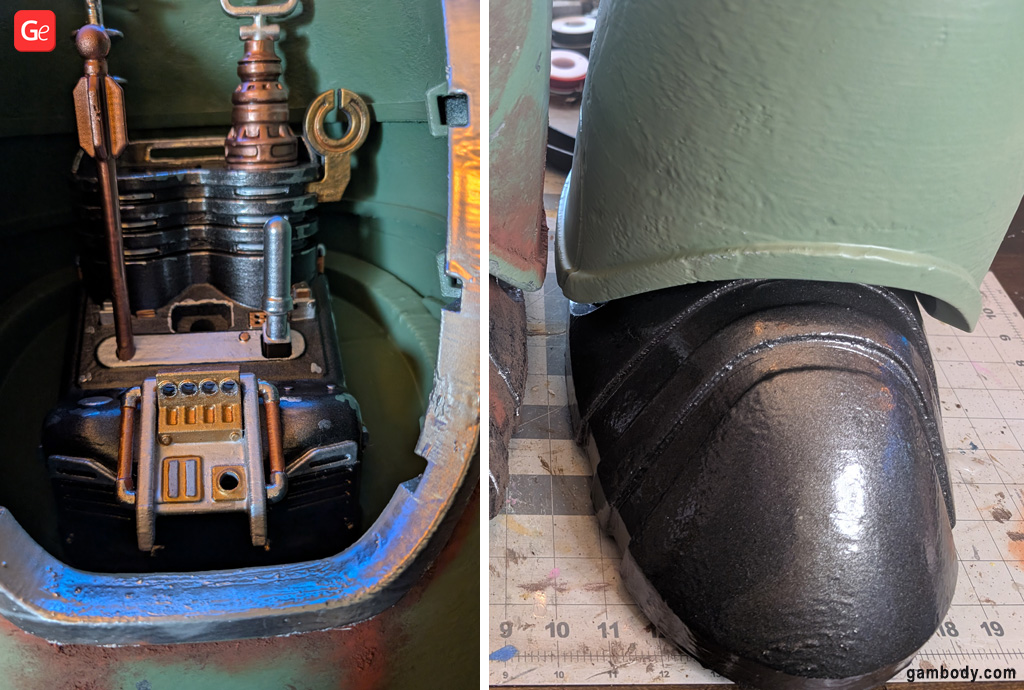
12. You are currently working on a Protectron life size 3D print. Why did you decide to add this iconic 3D printed robot to your lineup?
Not a big shocker here, but we love using Gambody 3D game models . We had made our full size Mr. Handy/snip base on the Codsworth 3D model and knew that Gambody STL files just worked when it came to scaling.
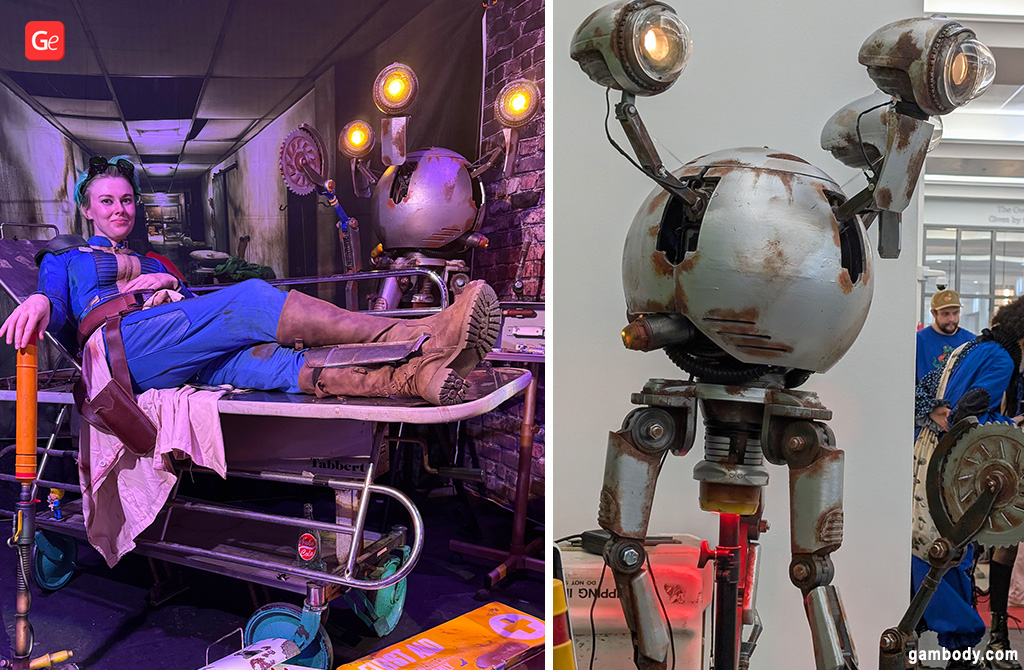
We saw the Protectron 3D model on Gambody sometime in the fall and fell in love with it. Enjoying to 3D print Fallout characters, we decided, since the Deathclaw was done, to move on to the next awesome build! I think making 3D printed robots from the Fallout universe is just as awesome as the creatures. They all bring something to the set.
Read also: Walking Terminator Endoskeleton (How a Humanoid Robot Became a Nightmare Animatronic).
13. Are you planning to integrate lighting, sound effects, or moving elements into this new Fallout life size 3D print?
Oh, absolutely! Not only will the top brain have tons of LEDs, it will also have a rotating comm antenna. I had originally planned to do the same with the back engine compartment. I decided though that the back compartment would be used to house all the LED controllers, logic, and power distribution systems for the brain.
We have been keeping this kind of close to the chest, but we also have plans to make it a fully interactive AI chatbot. There is a startup in Australia who is making the AI chatbot, as we speak, and I have a fellow creator by the name of 5NovCreations that is also planning a life size 3D print of Protectron, so we have been collaborating a bit as we progress.
14. When will fans be able to see it in person — perhaps at MEGACON Orlando 2026?
Peter the Protectron will be debuted at MEGACON Orlando 2026, March 19th through the 22nd, alongside Dicky, Mr. Handy, and a ton of our other 3D printed creations.
15. You have a packed 2026 schedule, including MEGACON Orlando, Fallout Fan Celebration in West Virginia, Infinity Con Tallahassee, GCX Orlando, and ThunderCon Georgia. Which of these events feel the most ambitious for you, and what can fans expect from The Fallout Xperience?
It’s a tie between Megacon and the West Virginia event. Megacon will be by and far the largest convention we have done, and the first time we will have a dedicated room to operate out of (W306 by the way). But West Virginia will be the first time we are going to travel that far from our home base in Jacksonville, FL.
16. As a self-funded charity group, how do large-scale 3D printed characters help you draw attention to your mission?
Having large exhibits that no one else does is definitely a draw for crowds. People can see it from a distance and whether you know the source material or not they are always drawn to it, and effectively to us.
17. We’re looking forward to seeing your 3D printed Vault Boy, too! Could you share any additional plans or ambitions you have for future 3D printing projects or ideas? Perhaps Power Armor Fallout 3D print?
We actually already have a full set of T-60 that we use, but Autumn is building another set. My wife really wants me to make a set of the Cryptid Hunter Power Armor from Fallout 76 for her, but so far, no STL files have been made available anywhere, so that’s a 3D printing project on standby till I can manage to get some files for it. We still have plans for a mirelurk at some point, but that also requires premium files of 3D game models (it’s a running trend). Making huge, life size 3D prints requires specialized files, which are tough to get lmao.
Get inspired by impressive Fallout props 3D printed by Tyler, and visit the Fallout Xperience exhibit if you ever get a chance! Keep making impressive life size 3D prints from your favorite universes and share your experience with Gambody enthusiasts on Facebook. With a 3D printer, one is able to survive, or even thrive, in the post-apocalyptic wasteland.

Egg-celent Easter 3D Prints that Wow: Use STL Files of Most Amazing Models
Read Article
25 Best Models to 3D Print at Home: June Trends 2020
Read Article